

新疆石油地质 ›› 2026, Vol. 47 ›› Issue (1): 31-45.doi: 10.7657/XJPG20260104
陈楷睿1( ), 赵俊峰1(), 王江波2, 王刚2, 张鹏1
收稿日期:2025-02-28
出版日期:2026-02-01
发布日期:2026-01-23
通讯作者:
赵俊峰
E-mail:2713823137@qq.com;zjf@nwu.edu.cn
作者简介:陈楷睿(1998-),男,甘肃临夏人,硕士,沉积学与石油地质学,(Tel)19115918868(Email)基金资助:
CHEN Kairui1(), ZHAO Junfeng1(), WANG Jiangbo2, WANG Gang2, ZHANG Peng1
Received:2025-02-28
Online:2026-02-01
Published:2026-01-23
Contact:
ZHAO Junfeng
E-mail:2713823137@qq.com;zjf@nwu.edu.cn
摘要:
吐哈盆地中—下侏罗统水西沟群整体发育河流-三角洲-湖泊沉积体系,然而,盆地经历了多期构造运动改造,中—下侏罗统水西沟群沉积时期的古地貌格局,是其沉积演化特征的主控因素。综合利用钻井、地震、岩心和野外露头资料,结合前人研究工作,开展中—下侏罗统水西沟群沉积演化特征的综合分析。研究表明,中—下侏罗统水西沟群整体表现为北厚南薄的特征,由早侏罗世早期多个分离的小型沉积中心,至中侏罗世向台北凹陷迁移,形成大型统一的沉积中心。盆缘山系和盆内主要隆起的构造抬升运动塑造了中—下侏罗统水西沟群古地貌及沉积-物源格局,中—下侏罗统水西沟群沉积时期主要受南北双向物源体系的控制,其次也有来自盆内隆起的物源补给。盆地南部的古隆起形成时间早,为主要物源区,盆地南部发育远源三角洲体系。博格达局部隆起和布尔加凸起在水西沟群沉积时期持续抬升,为次要物源区。湖平面频繁升降是影响该时期沉积体系分布的另一重要因素,湖侵早期(八道湾组沉积时期)和湖退晚期(西山窑组沉积早期)盆内广泛分布三角洲平原亚相,是重要的聚煤期。三工河组沉积时期是早—中侏罗世最大的湖侵期,该时期形成了中—下侏罗统水西沟群优质的湖相烃源岩。
中图分类号:
陈楷睿, 赵俊峰, 王江波, 王刚, 张鹏. 吐哈盆地中—下侏罗统水西沟群沉积演化特征[J]. 新疆石油地质, 2026, 47(1): 31-45.
CHEN Kairui, ZHAO Junfeng, WANG Jiangbo, WANG Gang, ZHANG Peng. Sedimentary Evolution of the Lower-Middle Jurassic Shuixigou Group in the Turpan-Hami Basin[J]. Xinjiang Petroleum Geology, 2026, 47(1): 31-45.
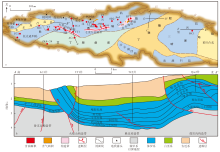
图1
吐哈盆地构造分区(a)及南北向地质剖面(b)(据文献[1]、文献[3]和文献[4]修改)"


图2
吐哈盆地主要构造单元中—下侏罗统水西沟群综合柱状剖面"
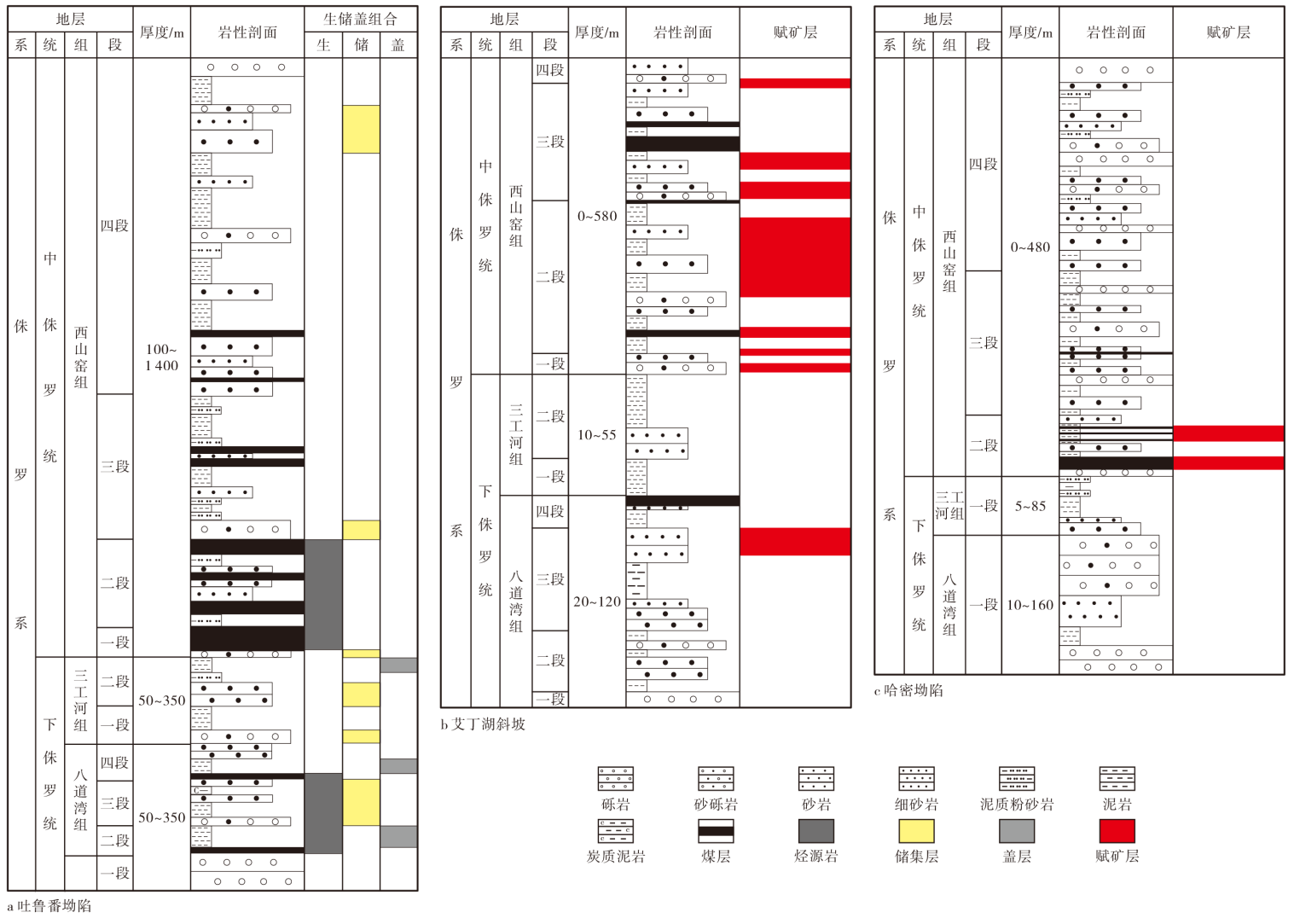
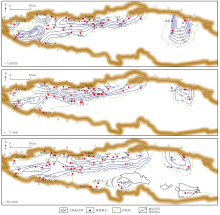
图3
吐哈盆地中—下侏罗统水西沟群分布(据文献[26]、文献[27]和文献[33]修改)"

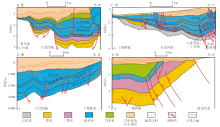
图4
吐哈盆地内部各隆起周缘古地貌格局示意图(剖面位置见图1a)"

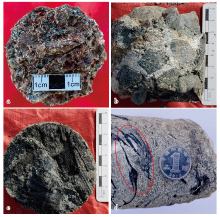
图5
吐哈盆地西山窑组典型沉积相岩心特征 a—砂质砾岩发育赤铁矿,ZKQ3-4井,576.75 m;b—灰色砾岩,ZKQ4-2井,420.70 m;c—碳化植物碎屑,ZKQ4-2井,480.40 m;d—灰色含砾细砂岩夹煤线,ZKD4-1井,140.10—140.30 m。"

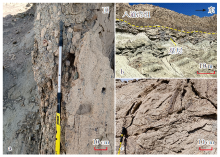
图6
吐哈盆地八道湾组冲积扇和辫状河沉积露头特征 a—河床滞留沉积,克尔碱露头;b—灰白色砂岩夹泥岩,发育煤层,桃树园露头;c—辫状河道砂体,可见植物茎秆,克尔碱露头。"

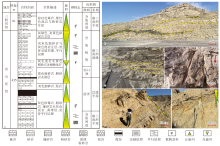
图7
煤窑沟露头西山窑组—三间房组扇三角洲沉积露头特征 a—煤窑沟剖面沉积柱状剖面;b—灰白色、灰黄色砂岩、细砂岩夹煤层,西山窑组;c—灰黄色分流河道砂砾岩,三间房组;d—植物茎秆,三间房组;e—灰黄色、灰绿色细砂岩与泥岩互层,发育下细上粗的反旋回,西山窑组;f—灰绿色泥岩,西山窑组。"

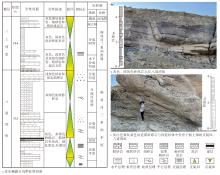
图8
克尔碱露头下侏罗统辫状河三角洲沉积特征"


图9
吐哈盆地十红滩地区西山窑组二段辫状河三角洲前缘沉积露头特征 a—灰黄色和灰绿色砂岩与泥岩互层,发育下细上粗的反旋回;b—灰黄色水下分流河道砂体,交错层理;c—灰黄色水下分流河道砂体,平行层理和小型交错层理。"

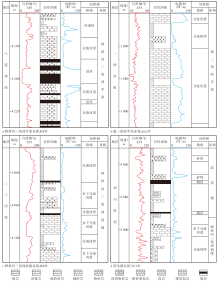
图10
吐哈盆地中—下侏罗统主要沉积相的典型测井响应特征"

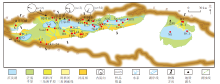
图11
吐哈盆地侏罗系八道湾组沉积相分布"
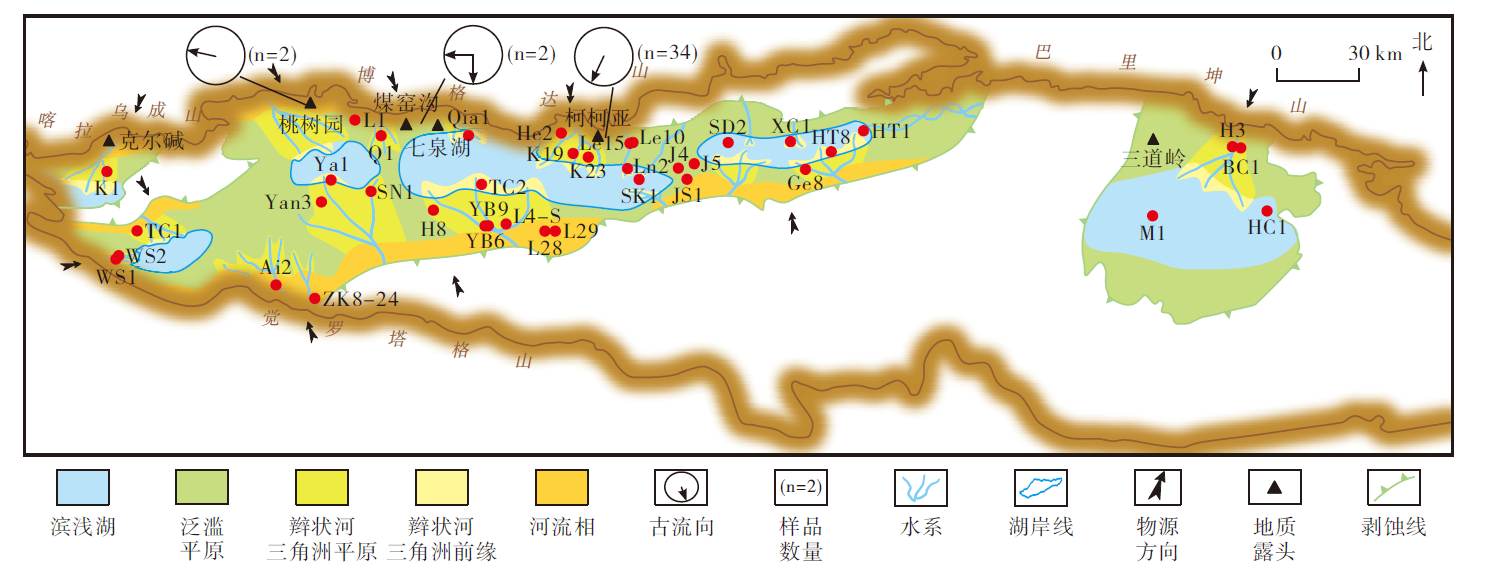

图12
吐哈盆地侏罗系三工河组沉积相分布"

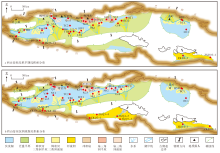
图13
吐哈盆地侏罗系西山窑组沉积早期及晚期沉积相分布"

| [1] | 梁世君. 吐哈探区油气勘探成果及潜力[J]. 新疆石油地质, 2020, 41(6):631-641. |
| LIANG Shijun. Achievements and potential of petroleum exploration in Tuha oil and gas province[J]. Xinjiang Petroleum Geology, 2020, 41(6):631-641. | |
| [2] | 支东明, 李建忠, 陈旋, 等. 吐哈探区深层油气勘探进展及潜力评价[J]. 新疆石油地质, 2023, 44(3):253-264. |
| ZHI Dongming, LI Jianzhong, CHEN Xuan, et al. Exploration progress and potential evaluation of deep oil and gas in Turpan-Hami exploration area[J]. Xinjiang Petroleum Geology, 2023, 44(3):253-264. | |
| [3] | 支东明, 陈旋, 杨润泽, 等. 准噶尔盆地东部残留海相凹陷勘探实践及全油气系统[J]. 新疆石油地质, 2024, 45(2):127-138. |
| ZHI Dongming, CHEN Xuan, YANG Runze, et al. Exploration practice and total petroleum system in residual marine sag,eastern Junggar Basin[J]. Xinjiang Petroleum Geology, 2024, 45(2):127-138. | |
| [4] | 吉斐, 孙鑫鑫, 张琦. 新型产量递减方程的建立及渗流理论基础:以吐哈油田非常规油藏为例[J]. 新疆石油地质, 2024, 45(6):696-702. |
| JI Fei, SUN Xinxin, ZHANG Qi. Establishment of a new production decline equation and its theoretical basis:A case study of unconventional reservoirs in Tuha oilfield[J]. Xinjiang Petroleum Geology, 2024, 45(6):696-702 | |
| [5] | 聂逢君, 张成勇, 姜美珠, 等. 吐哈盆地西南缘地区砂岩型铀矿含矿目的层沉积相与铀矿化[J]. 地球科学, 2018, 43(10):3584-3602. |
| NIE Fengjun, ZHANG Chengyong, JIANG Meizhu, et al. Relationship of depositional facies and microfacies to uranium mineralization in sandstone along the southern margin of Turpan-Hami Basin[J]. Earth Science, 2018, 43(10):3584-3602. | |
| [6] | 程银行, 金若时, MICHEL C, 等. 中国北方盆地大规模铀成矿作用:地层篇[J]. 地质学报, 2024, 98(7):1953-1976. |
| CHENG Yinhang, JIN Ruoshi, MICHEL C, et al. The strata constraint on large scale sandstone-type uranium mineralization in Meso-Cenozoic basins,northern China[J]. Acta Geologica Sinica, 2024, 98(7):1953-1976. | |
| [7] | 梁开华, 齐争辉, 王文龙, 等. 吐哈盆地大南湖煤田西段中侏罗世西山窑组古地理及聚煤模式[J/OL]. 煤炭学报,[2025-02-21]. https://doi.org/10.13225/j.cnki.jccs.2024.12311-11. |
| LIANG Kaihua, QI Zhenghui, WANG Wenlong, et al. Paleogeography and coal accumulation model of the Middle Jurassic Xishanyao formation in western Dananhu coalfield of Turpan-Hami Basin[J/OL]. Journal of China Coal Society,[2025-02-21]. https://doi.org/10.13225/j.cnki.jccs.2024.12311-11. | |
| [8] |
HENDRIX M S, GRAHAM S A, CARROLL A R, et al. Sedimentary record and climatic implications of recurrent deformation in the Tian Shan:Evidence from Mesozoic strata of the north Tarim,south Junggar,and Turpan Basins,northwest China[J]. GSA Bulletin, 1992, 104(1):53-79.
doi: 10.1130/0016-7606(1992)104<0053:SRACIO>2.3.CO;2 |
| [9] | 喻春辉, 蒋宜勤, 刘树辉. 准噶尔盆地与吐哈盆地侏罗纪沉积边界的探讨[J]. 岩相古地理, 1996, 16(6):48-54. |
| YU Chunhui, JIANG Yiqin, LIU Shuhui. Jurassic sedimentary boundary between the Junggar and Turpan-Hami Basins in Xinjiang[J]. Sedimentary Facies and Palaeogeography, 1996, 16(6):48-54. | |
| [10] |
SHAO Lei, STATTEGGER K, LI Wenhou, et al. Depositional style and subsidence history of the Turpan Basin (NW China)[J]. Sedimentary Geology, 1999, 128(1/2):155-169.
doi: 10.1016/S0037-0738(99)00066-4 |
| [11] | GREENE T J, CAEEOLL A R, HENDRIX M S, et al. Sedimentary record of Mesozoic deformation and inception of the Turpan-Hami Basin,northwest China[J]. Memoirs of the Geological Society of America, 2001,317-340. |
| [12] | 张晶, 郝彬, 李双文, 等. 吐鲁番坳陷侏罗系物源体系变迁及其油气意义[J]. 中国矿业大学学报, 2020, 49(4):730-741. |
| ZHANG Jing, HAO Bin, LI Shuangwen, et al. Changes of Jurassic provenance system in Turpan depression and its oil and gas exploration significance[J]. Journal of China University of Mining & Technology, 2020, 49(4):730-741. | |
| [13] | 郝爱胜, 吴浩, 冉启贵, 等. 吐哈盆地台北凹陷三工河组二段物源与沉积体系研究[J]. 中国矿业大学学报, 2021, 50(5):893-908. |
| HAO Aisheng, WU Hao, RAN Qigui, et al. Provenance and depositional systems of the second member of Lower Jurassic Sangonghe formation in Taibei sag,Turpan-Hami Basin,China[J]. Journal of China University of Mining & Technology, 2021, 50(5):893-908. | |
| [14] | 李勇, 邵磊. 吐哈盆地侏罗系沉积特点及油气资源[J]. 西北大学学报(自然科学版), 2004, 34(6):698-702. |
| LI Yong, SHAO Lei. Sedimentary environments and petroleum resource of Jurassic rock in the Turpan Basin[J]. Journal of Northwest University(Natural Science Edition), 2004, 34(6):698-702. | |
| [15] | 姚丽景, 于炳松, 樊太亮, 等. 吐鲁番坳陷中—下侏罗统沉积体系再认识[J]. 现代地质, 2007, 21(2):397-405. |
| YAO Lijing, YU Bingsong, FAN Tailiang, et al. Sedimentary system rerecognition of Mid-Lower Jurassic in Turpan depression[J]. Geoscience, 2007, 21(2):397-405. | |
| [16] | 穆朋飞, 刘丰, 汪文斌, 等. 吐哈盆地丘东洼陷侏罗系水西沟群沉积相研究[J]. 长江大学学报(自然科学版), 2009, 6(1):182-184. |
| MU Pengfei, LIU Feng, WANG Wenbin, et al. The research about Shuixigou group of sedimentary facies in the Qiudong subsag of Tuha Basin[J]. Journal of Yangtze University(Natural Science Edition), 2009, 6(1):182-184. | |
| [17] |
吴青鹏, 杨占龙, 姚军, 等. 吐哈盆地北部山前带中下侏罗统水西沟群成藏条件及勘探方向[J]. 岩性油气藏, 2021, 33(6):1-11.
doi: 10.12108/yxyqc.20210601 |
|
WU Qingpeng, YANG Zhanlong, YAO Jun, et al. Reservoir forming conditions and exploration prospect of Middle-Lower Jurassic Shuixigou group in northern piedmont belt of Turpan-Hami Basin[J]. Lithologic Reservoirs, 2021, 33(6):1-11.
doi: 10.12108/yxyqc.20210601 |
|
| [18] | 陈旋, 王居峰, 肖冬生, 等. 台北凹陷下侏罗统致密砂岩气成藏条件与勘探方向[J]. 新疆石油地质, 2022, 43(5):505-512. |
| CHEN Xuan, WANG Jufeng, XIAO Dongsheng, et al. Accumulation conditions and exploration direction of Lower Jurassic tight sandstone gas reservoirs in Taibei sag[J]. Xinjiang Petroleum Geology, 2022, 43(5):505-512. | |
| [19] | 马荣, 何建国, 张宁, 等. 吐哈盆地三道岭煤矿4号煤层煤岩组分特征及其成因分析[J]. 中国煤炭, 2023, 49(7):14-24. |
| MA Rong, HE Jianguo, ZHANG Ning, et al. Characteristics and genesis analysis of coal maceral in No.4 coal seam of Sandaoling coal mine in Tu-Ha Basin[J]. China Coal, 2023, 49(7):14-24. | |
| [20] | 王雁飞. 哈密大南湖煤田详查区沉积环境及聚煤规律[J]. 中国煤田地质, 2004, 16(4):36-37. |
| WANG Yanfei. Sedimentary environment and coal-accumulating patterns in Dananhu coalfield preliminary exploration area,Hami,Xinjiang[J]. Coal Geology of China, 2004, 16(4):36-37. | |
| [21] | 王一兵, 赵双友, 刘红兵, 等. 中国低煤阶煤层气勘探探索:以沙尔湖凹陷为例[J]. 天然气工业, 2004, 24(5):21-23. |
| WANG Yibing, ZHAO Shuangyou, LIU Hongbing, et al. Discussion on low rank coalbed methane exploration in China:By taking Sha’erhu sag as an example[J]. Natural Gas Industry, 2004, 24(5):21-23. | |
| [22] |
WU Liqun, JIAO Yangqun, GOGER M, et al. Sedimentological setting of sandstone-type uranium deposits in coal measures on the southwest margin of the Turpan-Hami Basin,China[J]. Journal of Asian Earth Sciences, 2009, 36(2/3):223-237.
doi: 10.1016/j.jseaes.2009.06.003 |
| [23] | 乔海明, 宋哲, 刘治国. 吐哈盆地十红滩层间氧化带砂岩型铀矿床的控矿构造及控矿机理探讨[J]. 东华理工大学学报(自然科学版), 2016, 39(3):217-222. |
| QIAO Haiming, SONG Zhe, LIU Zhiguo. The ore-controlling structures and ore-controlling mechanism of interlayer oxidation zone sandstone type uranium deposit in Shihongtan of Turpan-Hami Basin[J]. Journal of East China University of Technology(Natural Science), 2016, 39(3):217-222. | |
| [24] | 荆国强, 伍群, 王腾. 吐哈盆地十红滩铀矿床北带西山窑组第二岩性段沉积体系对铀成矿的控制作用[J]. 铀矿地质, 2021, 37(6):1001-1012. |
| JING Guoqiang, WU Qun, WANG Teng. Sedimentary system of the second lithologic member of Xishanyao formation and its control on uranium mineralization in the north belt of Shihongtan uranium deposit,Turpan-Hami Basin[J]. Uranium Geology, 2021, 37(6):1001-1012. | |
| [25] |
肖冬生, 王柏然, 姚宗森, 等. 吐哈盆地丘东洼陷三工河组致密砂岩油气成藏过程分析[J]. 天然气地球科学, 2024, 35(2):275-287.
doi: 10.11764/j.issn.1672-1926.2023.07.012 |
|
XIAO Dongsheng, WANG Boran, YAO Zongsen, et al. Hydrocarbon accumulation process analysis of tight sandstone reservoirs in Sangonghe formation,Qiudong sub-sag,Turpan-Hami Basin[J]. Natural Gas Geoscience, 2024, 35(2):275-287.
doi: 10.11764/j.issn.1672-1926.2023.07.012 |
|
| [26] |
ZHU Xinda, QU Xiyu, ZHANG Hua, et al. Characteristics and main controlling factors of the Sangonghe tight sandstone reservoirs in the Shengbei sub-sag of the Turpan-Hami Basin,China[J]. Marine and Petroleum Geology, 2025, 171:107181.
doi: 10.1016/j.marpetgeo.2024.107181 |
| [27] | 吴因业. 吐哈盆地侏罗系含煤沉积层序特征研究[J]. 石油勘探与开发, 1995, 22(5):35-39. |
| WU Yinye. A study on depositional sequence feature of Jurassic coal formation in Tu-Ha Basin[J]. Petroleum Exploration and Development, 1995, 22(5):35-39. | |
| [28] | 李文厚, 周立发, 柳益群, 等. 吐哈盆地沉积格局与沉积环境的演变[J]. 新疆石油地质, 1997, 18(2):135-141. |
| LI Wenhou, ZHOU Lifa, LIU Yiqun, et al. Evolution of sedimentary framework and environment of Turpan-Hami Basin[J]. Xinjiang Petroleum Geology, 1997, 18(2):135-141. | |
| [29] | 李华明. 吐哈盆地中、下侏罗统煤系沉积环境与煤沼有机相[J]. 新疆石油地质, 2000, 21(4):301-303. |
| LI Huaming. Sedimentary environment of coal measures strata and coal swamp organic phase of Middle-Lower Jurassic in Turpan-Hami Basin[J]. Xinjiang Petroleum Geology, 2000, 21(4):301-303. | |
| [30] |
SHAO Longyi, ZHANG Pengfei, HILTON J, et al. Paleoenvironments and paleogeography of the Lower and lower Middle Jurassic coal measures in the Turpan-Hami oil-prone coal basin,northwestern China[J]. AAPG bulletin, 2003, 87(2):335-355.
doi: 10.1306/09160200936 |
| [31] | 秦长文, 李宏伟, 蒋兵. 吐哈盆地侏罗系层序地层格架的建立[J]. 新疆石油地质, 2004, 25(1):33-36. |
| QIN Changwen, LI Hongwei, JIANG Bing. Establishment of Jurassic sequence framework in Turpan-Hami Basin[J]. Xinjiang Petroleum Geology, 2004, 25(1):33-36. | |
| [32] |
邵龙义, 高迪, 罗忠, 等. 新疆吐哈盆地中、下侏罗统含煤岩系层序地层及古地理[J]. 古地理学报, 2009, 11(2):215-224.
doi: 10.7605/gdlxb.2009.02.009 |
|
SHAO Longyi, GAO Di, LUO Zhong, et al. Sequence stratigraphy and palaeogeography of the Lower and Middle Jurassic coal measures in Turpan-Hami Basin[J]. Journal of Palaeogeography, 2009, 11(2):215-224.
doi: 10.7605/gdlxb.2009.02.009 |
|
| [33] | 袁明生, 梁世君, 燕列灿, 等. 吐哈盆地油气地质与勘探实践[M]. 北京: 石油工业出版社, 2002. |
| YUAN Mingsheng, LIANG Shijun, YAN Liecan, et al. Petroleum geology and exploration in Turpan-Hami Basin[M]. Beijing: Petroleum Industry Press, 2002. | |
| [34] | 邓胜徽, 卢远征, 樊茹, 等. 新疆北部的侏罗系[M]. 合肥: 中国科学技术大学出版社, 2010. |
| DENG Shenghui, LU Yuanzheng, FAN Ru, et al. The Jurassic system of northern Xinjiang,China[M]. Hefei: University of Science & Technology of China Press, 2010. | |
| [35] | 李玉宏, 赵峰华, 聂浩刚, 等. 新疆东部主要含煤盆地侏罗系聚煤规律[M]. 北京: 科学出版社, 2015. |
| LI Yuhong, ZHAO Fenghua, NIE Haogang, et al. Coal-accumulating regulation of main coal-bearing basins in the eastern Xinjiang area[M]. Beijing: China Science Press, 2015. | |
| [36] | 梁世君, 钱峰, 肖冬生. 吐哈盆地台北凹陷吉7H井侏罗系致密砂岩油气藏勘探发现与启示[J]. 中国石油勘探, 2022, 27(1):50-59. |
| LIANG Shijun, QIAN Feng, XIAO Dongsheng. Exploration discovery and implications of the Jurassic tight sandstone oil and gas reservoir in Well Ji7H in Taibei sag,Turpan-Hami Basin[J]. China Petroleum Exploration, 2022, 27(1):50-59. | |
| [37] | 黄蝶芳, 姜萌蕾, 邵满军, 等. 吐哈盆地北部山前带构造样式及演化特征[J]. 新疆石油地质, 2020, 41(6):651-657. |
| HUANG Diefang, JIANG Menglei, SHAO Manjun, et al. Structural style and evolution of northern piedmont belt in Turpan-Hami Basin[J]. Xinjiang Petroleum Geology, 2020, 41(6):651-657. | |
| [38] | 李成明, 刘俊田, 倪联斌, 等. 吐哈盆地深层地质结构特征及油气勘探前景[J]. 中国石油勘探, 2021, 26(4):44-57. |
| LI Chengming, LIU Juntian, NI Lianbin, et al. Characteristics of deep geological structure and petroleum exploration prospect in Turpan-Hami Basin[J]. China Petroleum Exploration, 2021, 26(4):44-57. | |
| [39] |
杨占龙, 肖冬生, 武超, 等. 吐哈盆地侏罗纪湖盆填充演化与油气成藏[J]. 天然气地球科学, 2025, 36(3):455-468.
doi: 10.11764/j.issn.1672-1926.2024.11.003 |
|
YANG Zhanlong, XIAO Dongsheng, WU Chao, et al. Infilling evolution and hydrocarbon accumulation of Jurassic in Turpan-Kumul Basin[J]. Natural Gas Geoscience, 2025, 36(3):455-468.
doi: 10.11764/j.issn.1672-1926.2024.11.003 |
|
| [40] | 杨占龙, 肖冬生, 周隶华, 等. 高分辨率层序格架下的陆相湖盆精细沉积体系研究:以吐哈盆地西缘侏罗系—古近系为例[J]. 岩性油气藏, 2017, 29(5):1-10. |
|
YANG Zhanlong, XIAO Dongsheng, ZHOU Lihua, et al. Depositional system of lacustrine basins within high-resolution sequence framework:A case of Jurassic to Paleogene in western Turpan-Kumul Basin[J]. Lithologic Reservoirs, 2017, 29(5):1-10.
doi: 10.3969/j.issn.1673-8926.2017.05.001 |
|
| [41] | 张凯. 十三间房探区地震资料解释及构造分析[D]. 山东青岛: 中国海洋大学, 2014. |
| ZHANG Kai. Seismic data interpretation and structural analysis in 13 Rooms area[D]. Qingdao,Shandong: Ocean University of China, 2014. | |
| [42] | 吴志远. 十三间房及周围地区煤系烃源岩评价及油气成藏机制研究[D]. 北京: 中国矿业大学(北京), 2017. |
| WU Zhiyuan. Research on the coal-measure source rock evaluation and reservoir-forming mechanism in the Shisanjianfang and surrounding area[D]. Beijing: China University of Mining & Technology(Beijing), 2017. | |
| [43] | 周海廷. 哈密坳陷地层研究与原型盆地恢复[D]. 山东青岛: 中国海洋大学, 2012. |
| ZHOU Haiting. The research of stratum characteristics and restored prototype basin in Hami depression[D]. Qingdao,Shandong: Ocean University of China, 2012. | |
| [44] | 宋传会. 哈密坳陷断裂特征与构造演化研究[D]. 山东青岛: 中国海洋大学, 2012. |
| SONG Chuanhui. Research on the fault features and structural evolution of Hami depression[D]. Qingdao,Shandong: Ocean University of China, 2012. | |
| [45] | 范世武. 吐哈盆地大河沿地区河1井区石油地质条件分析[D]. 山东青岛: 中国石油大学(华东), 2020. |
| FAN Shiwu.Analysis of petroleum geological conditions of He 1 well area in Daheyan area,Turpan Hami Basin[D]. Qingdao,Shandong: China University of Petroleum(East China), 2020. | |
| [46] | 姜美珠, 聂逢君, 张成勇, 等. 吐哈盆地克尔碱向斜构造特征与砂岩型铀矿目的层沉积相、微相及其找矿意义[J]. 东华理工大学学报(自然科学版), 2018, 41(4):315-327. |
| JIANG Meizhu, NIE Fengjun, ZHANG Chengyong, et al. Characteristics of tectonics and depositional facies and microfacies of sandstone-type uranium host rocks and significance for exploration in Ke’erjian syncline,Turpan-Hami Basin[J]. Journal of East China University of Technology(Natural Science), 2018, 41(4):315-327. | |
| [47] | 肖健旺. 吐哈盆地台北凹陷侏罗系三工河组沉积相及砂体展布研究[D]. 北京: 中国石油大学(北京), 2023. |
| XIAO Jianwang. Sedimentary facies and sand body distribution of the Jurassic Sangonghe formation in the Taipei depression of the Tuha Basin[D]. Beijing: China University of Petroleum(Beijing), 2023. | |
| [48] |
何海清, 梁世君, 郭绪杰, 等. 吐哈盆地洼陷区中下侏罗统岩性油气藏风险勘探新发现及勘探前景[J]. 天然气地球科学, 2022, 33(7):1025-1035.
doi: 10.11764/j.issn.1672-1926.2022.02.004 |
|
HE Haiqing, LIANG Shijun, GUO Xujie, et al. New discoveries and exploration prospects of Middle and Lower Jurassic lithologic reservoirs in depression area of Turpan-Hami Basin[J]. Natural Gas Geoscience, 2022, 33(7):1025-1035.
doi: 10.11764/j.issn.1672-1926.2022.02.004 |
|
| [49] | 陈旋, 苟红光, 蔡鑫勇, 等. 吐哈盆地南缘晚石炭世火山活动及其对沉积环境的影响[J]. 矿物岩石, 2024, 44(3):165-180. |
| CHEN Xuan, GOU Hongguang, CAI Xinyong, et al. Late Carboniferous volcanic activity and its influence on sedimentary environment in southern margin of Turpan-Hami Basin[J]. Mineralogy and Petrology, 2024, 44(3):165-180. | |
| [50] | 李玮, 陈隽璐, 董云鹏, 等. 早古生代古亚洲洋俯冲记录:来自东天山卡拉塔格高镁安山岩的年代学、地球化学证据[J]. 岩石学报, 2016, 32(2):505-521. |
| LI Wei, CHEN Junlu, DONG Yunpeng, et al. Early Paleozoic subduction of the Paleo-Asian Ocean:Zircon U-Pb geochronological and geochemical evidence from the Kalatag high-Mg andesites,east Tianshan[J]. Acta Petrologica Sinica, 2016, 32(2):505-521. | |
| [51] |
MAO Qigui, WANG Jingbin, XIAO Wenjiao, et al. Mineralization of an intra-oceanic arc in an accretionary orogen:Insights from the Early Silurian Honghai volcanogenic massive sulfide Cu-Zn deposit and associated adakites of the eastern Tianshan(NW China)[J]. GSA Bulletin, 2018, 131(5/6):803-830.
doi: 10.1130/B31986.1 |
| [52] | 马志杰, 柴凤梅, 许强奋, 等. 东天山卡拉塔格晚石炭世岛弧火山岩发现的地质意义[J]. 地质科学, 2021, 56(3):683-700. |
| MA Zhijie, CHAI Fengmei, XU Qiangfen, et al. The discovery of Low Carboniferous arc volcanic rocks and its tectonic significance at the Kalatag area in the eastern Tianshan[J]. Chinese Journal of Geology, 2021, 56(3):683-700. | |
| [53] |
JI Hongjie, TAO Huifei, WANG Qi, et al. Early to Middle Jurassic tectonic evolution of the Bogda mountains,northwest China:Evidence from sedimentology and detrital zircon geochronology[J]. Journal of Asian Earth Sciences, 2018, 153:57-74.
doi: 10.1016/j.jseaes.2017.03.018 |
| [54] |
JI Hongjie, TAO Huifei, QIU Junli, et al. Provenance of Middle Jurassic clastic rocks from the Bogda area of eastern Tianshan and its implications[J]. International Geology Review, 2020, 62(10):1319-1342.
doi: 10.1080/00206814.2019.1647119 |
| [55] |
甄宇, 陈旋, 焦立新, 等. 东疆地区石炭纪—二叠纪构造古地理与原型盆地演化[J]. 古地理学报, 2024, 26(1):78-99.
doi: 10.7605/gdlxb.2024.01.001 |
|
ZHEN Yu, CHEN Xuan, JIAO Lixin, et al. Carboniferous-Permian tectonopalaeogeography and prototype basin evolution in eastern Xinjiang,NW China[J]. Journal of Palaeogeography, 2024, 26(1):78-99.
doi: 10.7605/gdlxb.2024.01.001 |
|
| [56] |
ZHAO Rui, ZHANG Jinyu, ZHOU Chuanmin, et al. Tectonic evolution of Tianshan-Bogda-Kelameili mountains,clastic wedge basin infill and chronostratigraphic divisions in the source-to-sink systems of Permian-Jurassic,southern Junggar Basin[J]. Marine and Petroleum Geology, 2020, 114:104200.
doi: 10.1016/j.marpetgeo.2019.104200 |
| [57] |
HAO Bin, XIAO Dongsheng, JIN Jikun, et al. Source‐to‐sink systems in the Turpan Basin throughout the Jurassic:Constraints from detrital zircon geochronology[J]. Geological Journal, 2022, 57(11):4781-4792.
doi: 10.1002/gj.v57.11 |
| [58] | 刘选. 吐哈盆地水西沟群致密砂岩储层特征及气藏成藏机理研究[D]. 山东青岛: 中国石油大学(华东), 2014. |
| LIU Xuan. Characteristics of the tight sandstone reservoir and accumulation mechanisms in the tight gas accumulation of Shuixigou group,Turpan-Hami Basin[D]. Qingdao,Shandong: China University of Petroleum(East China), 2014. | |
| [59] | 田兵. 吐哈盆地山前带中下侏罗统沉积体系分析与储层地质特征研究[D]. 山东青岛: 中国石油大学(华东), 2010. |
| TIAN Bing. Research on sedimentary facies and reservoir characteristics of Lower and Middle Jurassic of Bogeda foreland basin[D]. Qingdao,Shandong: China University of Petroleum(East China), 2010. | |
| [60] | 管彧照, 刘池洋, 张少华, 等. 吐哈盆地中北部中侏罗统重矿物组合特征及对博格达山隆升过程的约束[J]. 地质科学, 2018, 53(4):1389-1404. |
| GUAN Yuzhao, LIU Chiyang, ZHANG Shaohua, et al. The differential uplift of the Bogda Mountain: Constraints from the heavy mineral characteristic of Middle Jurassic deposits in the north-central Turpan-Hami Basin[J]. Chinese Journal of Geology, 2018, 53(4):1389-1404. |
| [1] | 杨玉芳, 肖强, 苏荣昆, 刘洪平, 张莉, 孟璐莹. 塔里木盆地雅克拉断凸周缘阳霞组沉积相[J]. 新疆石油地质, 2024, 45(6): 650-658. |
| [2] | 葛启兵, 刘倩, 马建红, 高文君. 一种新的油水相渗数学模型建立及应用——以吐哈盆地低黏油藏为例[J]. 新疆石油地质, 2024, 45(6): 725-734. |
| [3] | 支东明, 李建忠, 陈旋, 杨帆, 刘俊田, 林霖. 吐哈探区深层油气勘探进展及潜力评价[J]. 新疆石油地质, 2023, 44(3): 253-264. |
| [4] | 康积伦, 付国斌, 韩成, 梁辉, 马强, 梁桂宾, 陈高潮. 准噶尔盆地东部隆起石钱滩凹陷石钱滩组层序划分[J]. 新疆石油地质, 2023, 44(3): 265-276. |
| [5] | 刘锋, 赵红静, 金颖, 甘应星, 曾雁, 温旺彪, 徐桂芳. 吐哈盆地胜北洼陷中—下侏罗统致密油烃源岩评价及油源对比[J]. 新疆石油地质, 2023, 44(3): 277-288. |
| [6] | 周港, 程甜, 李杰, 陈安清, 李富祥, 徐慧, 徐胜林. 胜北洼陷三间房组致密储集层成岩作用及孔隙演化[J]. 新疆石油地质, 2023, 44(3): 289-298. |
| [7] | 肖志朋, 齐桓, 张艺桢, 李宜强, 姚帅旗, 刘通. 葡北油田三间房组油藏天然气重力驱特征及影响因素[J]. 新疆石油地质, 2023, 44(3): 334-340. |
| [8] | 万海乔, 王盛, 刘学良. 低孔低渗稠油油藏注水增能效果影响因素[J]. 新疆石油地质, 2023, 44(3): 347-351. |
| [9] | 朱永贤, 姚帅旗, 张彦斌, 韩继凡, 赵瑞明. 稀油油藏密闭取心流体饱和度校正方法[J]. 新疆石油地质, 2023, 44(3): 359-364. |
| [10] | 石楠, 刘源, 冷玥, 文一华, 潘海峰, 孙博, 王兵. 基于低频模型优化的相控地质统计学反演方法及应用[J]. 新疆石油地质, 2023, 44(3): 375-382. |
| [11] | 陈旋, 王居峰, 肖冬生, 刘俊田, 苟红光, 张华, 林霖, 李宏伟. 台北凹陷下侏罗统致密砂岩气成藏条件与勘探方向[J]. 新疆石油地质, 2022, 43(5): 505-512. |
| [12] | 于洪洲, 王越, 周健, 薛雁. 准噶尔盆地西北缘哈山地区二叠系风城组沉积体系[J]. 新疆石油地质, 2022, 43(4): 396-403. |
| [13] | 闵伟. 东营凹陷坨826块沙三段砂砾岩沉积特征[J]. 新疆石油地质, 2021, 42(4): 428-436. |
| [14] | 司学强, 袁波, 彭博, 冀冬生, 郭华军, 唐雪颖, 窦洋, 李亚哲. 准噶尔盆地南缘冲断带侏罗系喀拉扎组沉积特征[J]. 新疆石油地质, 2021, 42(4): 389-398. |
| [15] | 朱颜, 李艳然, 岳欣欣, 张辉, 李恒权, 张弛, 张新超. 车排子凸起胜金口组沉积相及主控因素[J]. 新疆石油地质, 2021, 42(1): 10-11. |
| 阅读次数 | ||||||
|
全文 |
|
|||||
|
摘要 |
|
|||||
